GREENGUARD Gold on an office chair means that the product is certified under UL Solutions’ chemical-emissions program at its Gold level, within the scope of its listing. It is useful evidence when you want to compare emissions claims. It is not a promise of zero emissions, a complete ingredient list, or a guarantee that every person will find the chair comfortable or symptom-free.
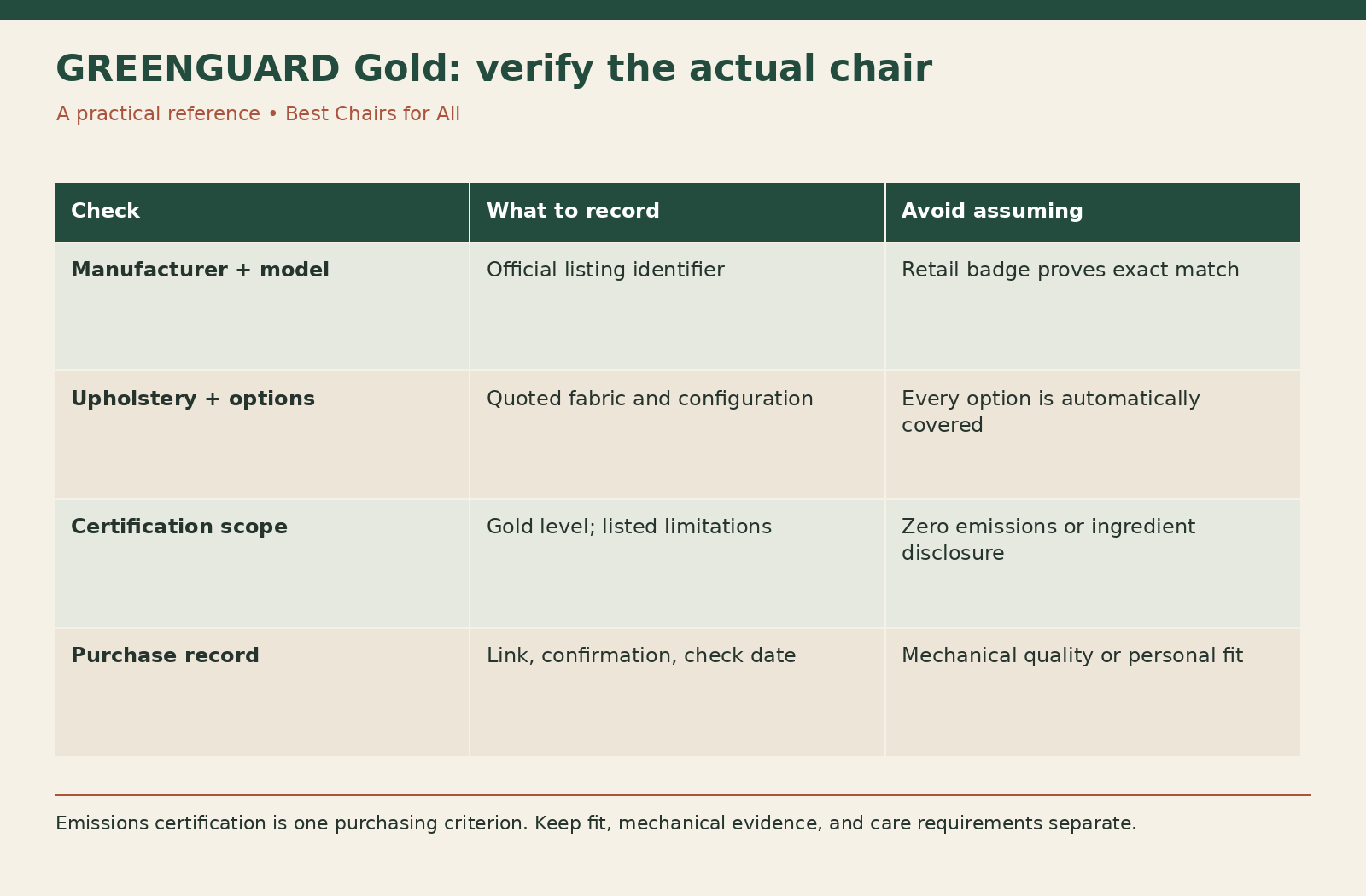
The most useful next step is to verify the actual chair in the certification listing. A retailer’s green badge can lose its meaning if it refers to a fabric, a different product family, or a version you are not buying. This guide provides a listing-check worksheet and a practical way to keep emissions evidence separate from other chair requirements.
What the program is measuring
The UL GREENGUARD certification page describes testing and emissions limits for indoor products. Gold applies stricter criteria than the program’s standard certification level and includes requirements associated with the California Department of Public Health chamber-testing method. Read the certification as an emissions claim under defined test conditions.
Emissions and ingredients are different kinds of information. An emissions test evaluates chemicals released under its method; an ingredient disclosure describes what materials or substances are in the product. Neither automatically gives you the other. A chair may contain a polymer, coating, adhesive, or foam and still have a relevant low-emissions certification.
Avoid converting the label into phrases such as “chemical-free” or “completely nontoxic.” Those are much broader than the documented claim. If a particular substance matters to your purchasing policy, ask the manufacturer for the specific evidence your policy requires instead of assuming the Gold logo answers every materials question.
Gold is not a chair-quality score
The certification does not rank recline comfort, fabric abrasion, caster suitability, or ease of repair. It also does not show that the chair’s seat depth and height will fit your body. A chair can have a useful emissions certification and still be a poor match for your desk or an unsuitable choice for a shared workstation.
For this reason, make emissions one column in your comparison sheet. Put fit, mechanical-performance evidence, supported user capacity, upholstery care, warranty, and service parts in separate columns. A product should meet the requirements that matter to your use rather than winning by collecting the greatest number of logos.
If a salesperson uses “Gold” as evidence that a chair is more durable than another chair, ask for the durability evidence separately. The word can sound like an overall quality tier, but its meaning here comes from the certification program. Keep the conversation anchored to the specific claim that UL’s listing supports.
Search the authoritative listing
UL’s SPOT product database information page explains its role as a source for sustainability certification listings. Search through the official service using the manufacturer and model or product-family name. Start with the manufacturer’s spelling rather than a retailer’s shortened product title.
Open the relevant result and compare the named product, certification level, scope, and any listed restrictions with the chair you plan to order. Save the listing or certificate information and the date you checked it. If the search returns a family rather than your exact retail name, ask the manufacturer to explain the mapping in writing.
Search failures are not automatically proof that the badge is false. A product may be listed under a legal company name, a collection name, or another identifier. Ask for the direct listing before drawing conclusions. If the manufacturer cannot connect the claimed chair to a current listing, treat the claim as unresolved in your decision sheet.
Check the upholstery and configuration
Office-chair families can have mesh seats, upholstered seats, leather options, special fabrics, and customer-supplied materials. Do not assume a certification statement covers every possible combination. Check whether the listing and manufacturer documentation cover the selected upholstery and other offered components.
This is especially relevant when buying through a dealer that customizes a chair. A standard product photograph may show certified factory upholstery while the quotation specifies a different fabric. Ask whether the certification remains applicable to the delivered configuration. The answer can depend on the program’s documented scope rather than the visual similarity of the materials.
The same caution applies to refurbished chairs. A listing for a new manufacturer’s product does not necessarily substantiate an emissions claim for an unknown replacement cushion, newly applied coating, or aftermarket upholstery. A refurbished chair may be a reasonable purchase, but its evidence should describe its actual condition and components.
Use this listing-verification worksheet
Create seven fields: manufacturer; exact chair or family; ordered upholstery and options; claimed certification level; official listing link or identifier; scope or limitations; and verification date. Add a final status of confirmed, clarification requested, or unresolved. This makes the decision reviewable without requiring you to copy an entire certificate into a spreadsheet.
For a hypothetical order, write “Chair family River, task version, fabric code F12, adjustable arms” rather than simply “green ergonomic chair.” If the listing covers River seating but the fabric is not clearly identified, mark the configuration as awaiting confirmation. Keep the original quotation alongside the answer so a later substitution does not silently change what you checked.
A useful supplier request is: “Please provide the official GREENGUARD Gold listing that covers the chair and upholstery in this quotation, and identify any excluded options.” This asks a narrow, answerable question. It is more useful than asking whether every material is safe, which the certification cannot establish for every possible person or exposure.
Work through a two-chair example
Imagine Chair A has a Gold badge on a marketplace page and no linked documentation. Chair B has a matching manufacturer listing that covers the quoted configuration. Your worksheet records A as unverified and B as documented for the emissions criterion. That is an evidence comparison, not an assertion that A emits more chemicals than B.
Now imagine A’s manufacturer supplies a valid matching listing. The emissions criterion may then be satisfied by both chairs. Move on to seat dimensions, adjustment range, serviceability, and total cost. Do not invent a meaningful emissions ranking between two certified chairs without comparable product-specific data and a reason to make that comparison.
Finally, imagine B fits poorly because its seat cannot shorten enough. The certification does not overcome that fit failure. Shortlist a chair that satisfies both your emissions requirement and your working dimensions. A certificate is most useful when it helps narrow a suitable set, rather than distracting from a basic mismatch.
Understand what odor can and cannot tell you
A noticeable smell is a reason to investigate the product and the room, but your nose cannot verify a chamber-test result. Absence of smell does not prove zero emissions, and an odor does not by itself show a certification is invalid. Avoid assigning chemical identities or exposure levels based on a description such as “new plastic smell.”
The EPA’s overview of volatile organic compounds indoors discusses source control, ventilation, and following product directions. Use that broader room perspective. New paint, cleaning supplies, flooring, and other furnishings may be present alongside the chair, so changing one purchase does not explain all indoor-air conditions.
Follow the chair manufacturer’s unpacking and care guidance. Do not apply fragranced sprays, solvents, ozone treatments, or heat as improvised ways to “finish off-gassing.” These actions introduce other variables and may damage materials. If a new chair has a persistent concerning odor, contact the seller within the return window and document the issue.
Make a sensible arrival plan
Before delivery, decide where packaging will be removed and where the chair can stand without blocking work or circulation. Retain the identifying label and compare the model with your order. Keep care instructions available so cleaning does not become a source of unsupported chemical treatment on the first day.
Use normal ventilation appropriate to the building and conditions. Do not put an indoor chair outdoors in rain or strong sun in the hope of accelerating an unmeasured process. Upholstery, mechanisms, and finishes have their own environmental limits. Any airing arrangement should remain consistent with the manufacturer’s storage and care instructions.
If someone experiences symptoms, avoid using the certification as grounds to dismiss their concern or to diagnose the chair as the cause. Stop the immediate activity if necessary, seek suitable professional advice, and investigate the workplace or room. A low-emissions certification is evidence about a product under a method, not an individualized medical clearance.
Keep related labels distinct
A mechanical ANSI/BIFMA chair-standard claim concerns different performance questions. A sustainability assessment may address multiple lifecycle or organizational criteria. Recycled-content statements concern material sourcing. These claims can coexist with GREENGUARD Gold, but none should be treated as interchangeable proof of the others.
Write the requirement in plain language before choosing which document to request. For example, “We require a current matching low-emissions listing” points to one kind of evidence, while “We require documented whole-chair mechanical compliance” points to another. This prevents an impressive certificate from answering the wrong procurement question.
Also separate company-level commitments from product-level claims. A manufacturer’s sustainability report may be useful background without identifying your chair’s certified configuration. Prefer the direct product listing for the certification question, then use broader reports only for the broader issues they actually address.
Keep the record useful after purchase
Store the listing link, supplier confirmation, configuration, and purchase date with the chair’s receipt. If the chair is reupholstered or fitted with replacement cushioning later, ask whether the original claim still covers that change. Do not copy the original badge onto a resale listing without checking what remains accurate.
For workplace batches, record the options consistently across all chairs. A later order may use a visually similar fabric or a revised model. Recheck the listing when the specification changes rather than assuming last year’s approval covers the new order.
GREENGUARD Gold is most valuable as a verifiable emissions criterion within a complete chair decision. Match the actual product to its scope, keep the documentation, and combine that evidence with dimensions, supported use, and practical service information. You can then explain exactly what the label establishes without promising more than the program measures.
Something unclear or out of date? Send a correction with this article’s title and the detail to check.
Sources, research & corrections policy ↗