Affiliate disclosure: As an Amazon Associate, Best Chairs for All earns from qualifying purchases. Read our disclosure. Amazon links below open matching US search listings; check the exact model, seller, configuration, availability, and checkout terms.
The best Herman Miller chair is the model whose support construction and controls suit your body and work. Try Aeron first if you want a suspended seat, Embody if you want an upholstered depth-adjustable seat with a whole-back fitting system, and Sayl if a foam cushion and open elastomer back suit you. This shortlist is a route through a showroom, not a claim that the most expensive chair is the best one.
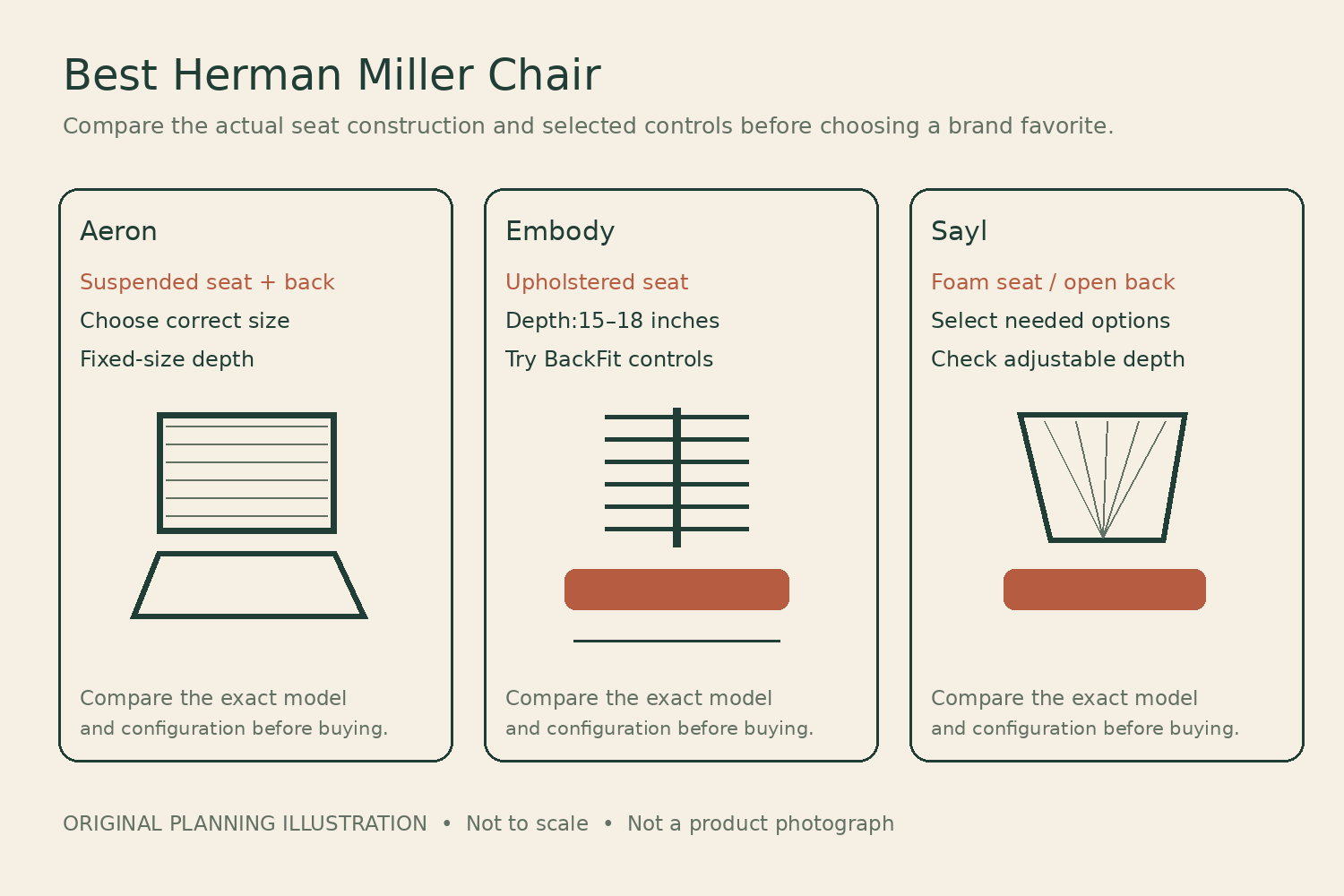
We checked current US manufacturer listings, adjustment guides, and a US retail route on November 6,2026. We have not conducted hands-on comparisons or measured productivity, circulation, comfort, or pain outcomes. The focus is on new US office-chair configurations. Older generations, gaming editions, stools, and international cylinders require their own specification checks.
Begin with the surface you sit on
Choosing within one brand can encourage a misleading assumption that the models form a simple ladder from good to better. These three chairs use different seat and back approaches. Aeron suspends the user above a frame; Embody provides an upholstered seat with depth adjustment; Sayl combines a foam cushion with an elastomer back. A preference for one surface does not become less valid because another carries a higher list price.
At a showroom, ask to compare contact before discussing finish. Sit in ordinary work clothing and shoes. Notice the seat’s front edge, side boundaries, and back relationship. Then perform a short real task and change position. A dramatic first impression should not outweigh a repeatedly uncomfortable contact during typing, reading, or leaving the chair.
Three models, three configuration decisions
| Model | Choose first | Adjustment distinction | Watch for |
|---|---|---|---|
| Aeron | Correct size and suspended-seat fit | Depth comes from size rather than slider | Current versus older size ratings |
| Embody | Upholstered contact and depth setting | BackFit and height/width arm adjustment | 300-pound rating; standard versus gaming version |
| Sayl | Foam-seat fit and back contact | Depth and several controls are option-dependent | Showroom options missing from basic order |
Review Aeron’s current US dimensions, Embody’s US listing, and Sayl’s current configuration choices. The distinction between fixed and adjustable depth is more important to this comparison than a generic count of ergonomic features.
1. Herman Miller Aeron Chair
Best for: Best starting trial if you specifically want suspended seating.
Aeron is the first model to try if an open suspended seat and back are the reason you are shopping Herman Miller. It changes the contact pattern from a foam cushion rather than simply adding a recognizable name to a conventional chair. Check the front and side frame contact with your own thighs. A well-known mesh design still needs a fit trial, and the fixed-size seat is the decision to settle before choosing colors.
The current US SizeB table gives 16–20.5 inches of height,16.75 inches of depth, and 350-pound capacity. Current A and C ratings are 300 and 400 pounds respectively. Those are current US listing values, not ratings to assign to every older Aeron. Support, tilt, arms, and casters remain configuration choices. The checked store offered ordering with a ship estimate tied to the displayed configuration.
Product Details
| Brand | Herman Miller |
|---|---|
| Seat construction | 8Z Pellicle suspended seat and back |
| Current US SizeB | 16–20.5-inch height;16.75-inch depth;350lb |
| Depth approach | Choose size; no conventional seat-depth slider |
| Warranty | 12 years; terms apply |
Pros
- Clearly different suspended contact from foam seating
- Three sizes allow a structured fitting comparison
- Manufacturer offers support and caster configurations
Cons
- Fixed frame and depth may fail an otherwise promising size
- Used generations require separate identification
Choose Aeron after comparing the size that fits your contacts, not merely the one a standing-height chart suggests. Obtain the exact support system and arm package in writing. Herman Miller states twelve-year warranty coverage under its eligible-purchase terms. A used unit with an aftermarket headrest or replacement cylinder needs its own history and approval questions; the current new-chair specification is not a universal certificate for it.
2. Herman Miller Embody Chair
Best for: Best adjustable-depth alternative when you prefer an upholstered seat.
Embody is the next trial when you want an upholstered seat and adjustable depth rather than choosing among Aeron seat sizes. Its current US page gives 15–18 inches of depth and a 16–20.5-inch height range, with a 300-pound rating. The seat and back use a different support construction, so try them independently instead of assuming that a more expensive model must improve on Aeron for every person.
The manufacturer guide identifies front seat-depth handles, arm height and width, and the BackFit adjustment behind the seat. It does not support casually calling every arm direction a four-way system. Ask a demonstrator to show the sequence and try the actual controls yourself. BackFit changes the back's relationship to the body rather than moving a separate lumbar pad up and down. Current US ordering was available for selected upholstery and base options.
Product Details
| Brand | Herman Miller |
|---|---|
| Seat height | 16–20.5 inches, current US listing |
| Seat depth | 15–18 inches |
| Capacity | 300lb |
| Arm adjustment in guide | Height and width |
| Back adjustment | BackFit controls whole-back relationship |
| Warranty | 12 years; terms apply |
Pros
- Depth range provides a distinct fitting route
- Whole-back adjustment differs from a discrete lumbar pad
- Upholstered seat for buyers who do not want suspension mesh
Cons
- 300-pound capacity differs from some current Aeron sizes
- Control access and back feel need a deliberate trial
Choose Embody if its contact surfaces and controls work through the tasks you actually do. Do not substitute a Logitech gaming edition's surface description or foam claim for the standard model selected here. The current US listing describes twelve-year coverage. Confirm the approved floor wheels and dispatch date, and request upholstery samples if the material choice determines your decision.
3. Herman Miller Sayl Chair Adjustable Seat Depth Configuration
Best for: Best foam-seat and open-back alternative with options chosen carefully.
Sayl is the comparison if you prefer a foam cushion with an open elastomer back and a different overall scale. The current US listing gives an 18-inch seat width,16–20.5-inch standard height, and 350-pound capacity. Its distinctive back is not Aeron's seat-and-back suspension system, and it should not be described as a smaller Aeron. The surface beneath you and the contact behind you are separate choices.
Sayl's depth can be fixed or adjustable depending on configuration. The adjustable option is listed at 16–18 inches. Its manual repeatedly marks features as available only on some models, including depth, forward tilt, lumbar, and particular arm directions. A low base configuration therefore cannot be compared fairly with another chair assumed to include every control. Both the manufacturer store and a checked DWR US page provided current ordering routes and configuration-dependent lead times.
Product Details
| Brand | Herman Miller |
|---|---|
| Current US standard height | 16–20.5 inches |
| Adjustable-depth choice | 16–18 inches; fixed option also exists |
| Published seat width | 18 inches |
| Capacity | 350lb |
| Support construction | Foam seat and elastomer suspension back |
| Warranty | 12 years; terms apply |
Pros
- Foam seat plus open back is a third construction to try
- Published18-inch seat width enables a useful screen
- Options allow a focused order when selected explicitly
Cons
- A basic order may omit the needed slider or arm controls
- Seat width and back contact can exclude some buyers
Choose Sayl when the seat fits and the exact option package includes the controls your trial used. Twelve-year coverage is described on current US listings, subject to terms. Ask the seller to identify the selected tilt, depth, lumbar, arms, and casters on the invoice. A favorable demonstration of an upgraded showroom unit is not evidence that the least expensive search result has the same configuration.
A showroom worksheet that keeps the comparison fair
Use the same task and desk relationship for each candidate. Have a fitter establish the main contacts, then operate the controls yourself. Ask permission to record the exact showroom configuration so the final quote can match it. A model name alone is not enough to reproduce the trial later.
- Identity: record model, size, generation, cylinder, seat and back material, arm package, support option, and casters.
- Contact: establish a useful height and depth with appropriate foot support. Note front-edge and side-frame contact without forcing yourself into a pose.
- Task: type a passage, use the pointing device, and read something at the intended display distance. Check whether the arm pads obstruct a close approach.
- Movement: try a controlled recline and return under the manual. Record which control changes the travel limit and which changes resistance.
- Repeatability: move one setting away and restore it. Confirm that you can reach and understand the control you would use at home.
For a worked screen, suppose a user establishes a comfortable usable depth near 15.5 inches during a fitting. Embody’s published 15–18-inch range includes that point; Sayl’s adjustable 16–18 range does not include it on paper, and Aeron requires its size-specific contact trial rather than a slider setting. That makes Embody a logical first demonstration, not a guaranteed winner. The exact loaded measuring convention and cushion contact still matter.
A second person might dislike an upholstered surface and find a correctly sized Aeron comfortable. That evidence can be more meaningful than the first person’s preference or an online ranking. Keep observations specific: which surface, which setting, which task, and what changed when you moved. Avoid declaring a chair universally firm, soft, narrow, or supportive from one brief impression.
Do not compare options by the family photograph
Sayl makes this especially clear. Its adjustment guide identifies several functions as model-dependent. An arm that adjusts in a showroom may be fixed in the lowest-priced online configuration. A photograph can show an attractive color without revealing which depth or tilt control is fitted.
Aeron also has different support and arm selections. Identify the actual back-support option rather than calling every lower-back attachment PostureFit SL. For Embody, the manufacturer guide describes its own BackFit and arm movements. Do not transfer the adjustment behavior of one model to another because both come from Herman Miller.
Keep body size and load rating separate
Current US Aeron ratings differ by size, with A at 300 pounds, B at 350, and C at 400 on the checked listing. Embody is rated 300 pounds and Sayl 350 in their current US tables. Those numbers do not define which seat shape will fit. A user can be within a capacity and still need a different height, width, or depth.
Also avoid copying a new generation’s rating onto a used chair. Ask for the actual unit’s identity and applicable documentation. A refurbished seat, replacement cylinder, or aftermarket attachment can raise additional questions about configuration and service eligibility. Treat the actual chair as the purchase rather than borrowing the reputation of its name.
Allow the desk and floor to participate in the trial
A chair can fit the body in isolation and still collide with a desk apron or make a fixed keyboard too high. Measure the actual opening, including drawers and frame rails. Try the arm position needed for work. If a chair fits but the furniture does not, decide which part of the workstation needs changing before attributing the entire problem to the seat.
Choose approved casters for the real rolling surface. A carpeted room with a rigid chair mat presents a different immediate wheel surface from bare carpet. Ask the supplier to confirm the option and keep it in the quote. Do not choose aftermarket wheels solely because they are advertised as universal or assume that a wheel change cannot alter the sitting-height relationship.
Buy the trial you can reproduce and the service you can reach
All three models had active US purchase routes when checked. The separate DWR Sayl listing also provided a current configuration and shipping route. These are availability observations for selected options, not promises of immediate stock or the same Amazon seller inventory. Confirm the dispatch estimate after choosing every option.
The current new-chair US listings describe twelve-year warranty coverage under their terms. Verify authorized purchase eligibility, location, intended use, and the claim route. Keep the serial label and invoice. A long defect warranty should not replace a suitable fit-return policy; ask what assembly, use, packaging, freight, and timing conditions apply if the chair feels wrong.
Choose Aeron if a correctly sized suspended seat wins your task trial, Embody if its upholstered depth range and BackFit controls solve the fit, or Sayl if its seat, back, and selected options already meet your needs. The most useful Herman Miller comparison ends with an exact configuration and a repeatable setting, not a status purchase or a universal winner.
Something unclear or out of date? Send a correction with this article’s title and the detail to check.
Sources, research & corrections policy ↗