A chair’s return policy and warranty solve different problems. Returns determine what you can do when a new purchase is unsuitable under the seller’s conditions. A warranty describes specified coverage when an eligible product develops a covered problem. A long warranty does not automatically let you send back a chair that feels uncomfortable, and a generous return window does not establish long-term repair coverage.
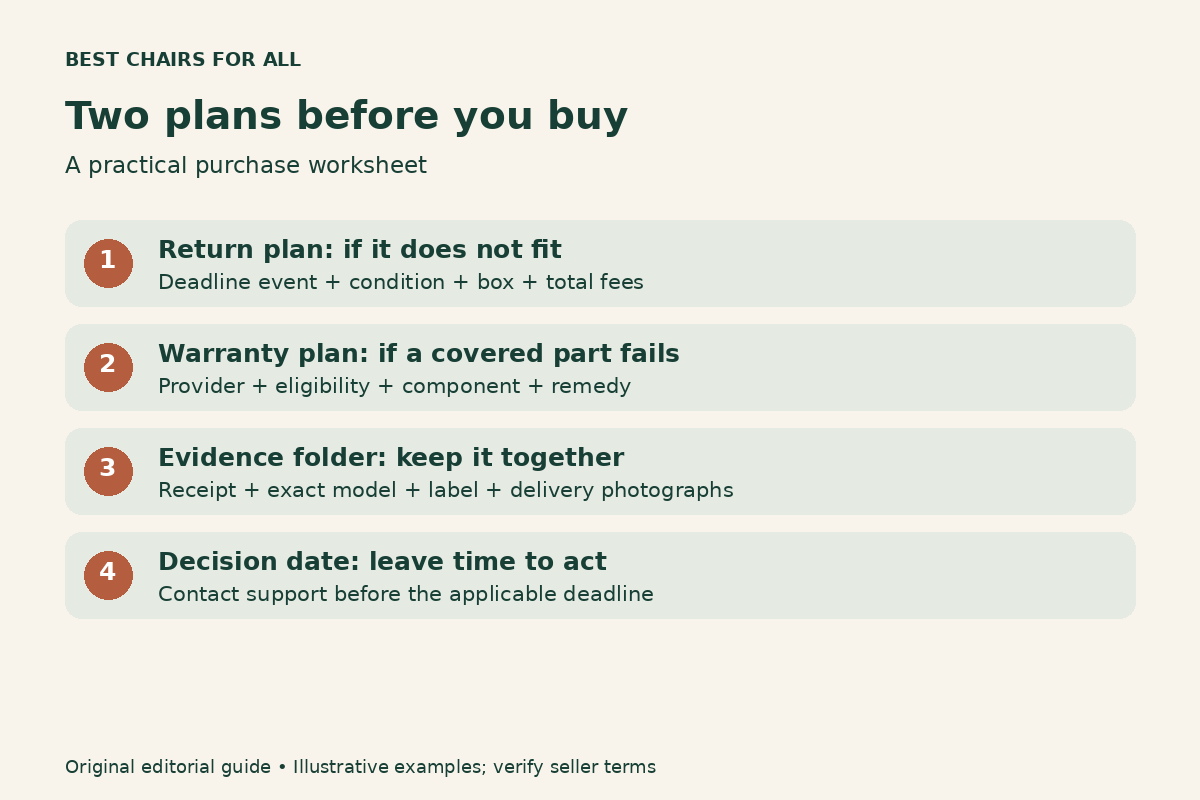
Before ordering, build two records: an exit plan for a poor fit, and a service plan for a later fault. This guide shows how to read the terms, compare the financial exposure, preserve useful evidence, and ask precise questions. The examples use official US sources reviewed on November 6, 2026; the terms applying to your actual order must be checked at purchase.
1. Identify the seller before reading the policy
Start with the business that will take payment and issue the invoice. On a marketplace, that may be a third-party seller rather than the manufacturer named in the title. Fulfillment, seller identity, and product branding are separate details. Save all three where the listing distinguishes them.
A direct-store policy should not be assumed to cover a dealer order. Steelcase Store US returns explicitly directs customers who purchased elsewhere to the original seller’s returns policy. That makes the seller field an essential part of your comparison, even when two listings show an identical model photograph.
Record the sales channel, country, product condition, and configuration. New, open-box, refurbished, clearance, and custom orders can have different terms. If the order includes several chairs, check quantity thresholds before assuming the individual-purchase policy applies. Ask about any conflict between a listing badge and the detailed policy.
2. Find the event that starts the clock
A policy can tie a deadline to ordering, dispatch, delivery, authorization, or warehouse receipt. Those are different events. Write down both the event and the number of days, then find out whether you must request a return or complete shipment before the deadline.
Do not translate a statement such as contact us within a stated period into an assumed period for unlimited trial and subsequent packing. Ask when the request must arrive, how long authorization takes, and when the carrier must receive the chair. Save the answer with the order confirmation.
For planning, place an early decision date on your calendar as well as the formal deadline. Leave time to contact support, obtain packaging if permitted, and arrange collection. This buffer is your organizational choice, not an extra right granted by the seller. Report damage or missing parts as soon as you discover them.
3. Define what returnable condition means
Find the wording about assembly, signs of use, tags, modification, damage, cleanliness, and packaging. A returnable chair is not necessarily a chair that can be altered, used indefinitely, or dismantled in any manner you choose. Ask the seller what evaluation is permitted when the policy is unclear.
Check particularly carefully before removing nonessential labels, fitting third-party parts, or attempting a repair. Keep the assembly instructions and hardware. Use the chair on an appropriate surface and follow its care guide; an avoidable scratch or incorrectly assembled component can complicate an otherwise straightforward request.
Photograph the unopened package, protective materials, chair surfaces, and model label during unpacking. These photographs provide a record of what arrived and how it was packed. They do not guarantee acceptance of a claim, but they make it easier to explain a specific problem without relying on memory.
4. Calculate the amount you may lose on a return
| Cost line | What to find in the terms |
|---|---|
| Outbound delivery | Is the original delivery charge refundable? |
| Return transport | Fixed fee, percentage, prepaid label, or buyer-arranged freight? |
| Restocking | Percentage base, minimum, maximum, and exceptions |
| Packaging | Original box required, replacement available, or separate cost? |
| Services | Assembly, installation, collection, or in-home delivery exclusions |
For a hypothetical $500 chair, a 10% restocking charge would be $50 before any separate transport or nonrefundable services. If the seller calculates the percentage on a different base, use that base. A policy that says a label is provided does not by itself tell you that the label is free.
Write two totals: cash needed to order and maximum known cost of returning an unsuitable but undamaged chair. Avoid treating uncertain fees as zero. Ask for a written estimate if the policy requires buyer-arranged freight. A large assembled chair can require a different shipping plan from the compact carton shown in the original listing.
5. Compare policy examples without generalizing them
Official policies illustrate why exact terms matter. The Steelcase Store US policy reviewed for this guide lists eligible ergonomic chairs with free returns within 30 days of delivery in the contiguous United States, subject to stated conditions. It treats custom and bulk orders separately. Verify that your model, quantity, location, and condition qualify before relying on that example.
The Herman Miller Store US returns page reviewed for this guide lists a $99 return shipping charge for Herman Miller branded performance seating. It describes a different restocking arrangement when packaging is unavailable and says original shipping and delivery charges are nonrefundable. Refurbished and final-sale products have separate restrictions.
These summaries are deliberately incomplete; use the linked policy for the actual conditions. A seller may update fees, classifications, or eligibility after this article is published. Save a dated copy of the policy governing your order and resolve ambiguity with the seller before paying, especially for custom upholstery or unusual delivery destinations.
6. Read a warranty by component and eligibility
Put the warranty document beside the product specification rather than relying on the largest number in an advertisement. Look for covered components, coverage periods, eligible purchasers, purchase channels, geography, intended use, user limits, exclusions, and remedies. Different components may have different coverage.
Ask whether the promise comes from the manufacturer, the retailer, a refurbisher, or a separate service-contract provider. Those organizations can have different obligations and service processes. Do not assume that a secondhand purchase inherits the original purchaser’s coverage or that a seller’s restoration warranty is the manufacturer’s warranty.
Steelcase Store FAQs and warranty eligibility identifies purchase-channel and geographic eligibility for its consumer warranty. For any brand, confirm the exact document that applies to the order. A dealer’s email describing warranty length is useful evidence of what was represented, but obtain the underlying terms before treating the description as complete.
7. Find out how repair actually happens
A warranty’s usefulness depends partly on the service route. Ask who diagnoses a problem, whether you supply photographs, whether parts ship to you, and whether an authorized technician performs the work. Find out who pays any transport, labor, or inspection charge under the applicable terms.
Herman Miller US warranty and service tells customers to begin with the dealer or retailer where they purchased the product. Its service guidance requests product identification and photographs of the issue, with video when appropriate. That is a practical reason to keep a receipt and a legible manufacturing-label photograph from the start.
Also ask about what happens outside coverage. Can the seller identify replacement parts for your exact model? Is local service available? A chair can be repairable even when a particular issue is not covered, but availability and cost need confirmation. Do not attempt a structural, pressurized-cylinder, or powered-mechanism repair merely to avoid asking about service.
8. Do not confuse discomfort, damage, and a defect
Describe the problem accurately when you contact support. A seat that is too deep for your legs is a fit issue unless it differs from the ordered specification. Torn upholstery visible at unpacking is an arrival-condition issue. A control that stops operating may require diagnosis against the instructions and warranty terms.
Separating those descriptions helps the seller route the request. It also prevents you from waiting for a warranty response while a fit-return deadline passes. If more than one issue exists, document each and ask which process preserves the available options.
A claim that a chair is ergonomic does not promise that it will suit every user. OSHA chair fitting guidance advises trying different chairs and fitting the chair in conjunction with the workstation. That supports treating fit evaluation as a separate purchasing task, rather than expecting warranty coverage to resolve every mismatch.
9. Use a structured request with useful evidence
Send the order number, seller name, delivery date, product model, and a short description of the requested outcome. State whether you are requesting a return for unsuitable fit, reporting arrival damage, or seeking service for an operational problem. Attach clear photographs rather than a large collection without explanations.
For a mechanical symptom, describe when it occurs and which normal adjustment you were using. Avoid guessing the failed part as though diagnosis were certain. A short video may be useful if requested. Stop using a chair that appears structurally unstable or damaged and seek the appropriate support route.
Keep the written response, authorization number, shipping label, packing instructions, collection record, tracking, and proof of delivery. Photograph the packed return before closing the carton. Ask how and when a refund or repair update will be communicated so you know when a follow-up is appropriate.
A short message to resolve missing terms
Use a specific question before purchasing: I am considering this exact chair configuration, delivered to this ZIP code. If it proves unsuitable after assembly and careful evaluation, may I return it? Please confirm the event that starts the deadline, the condition required, the packaging arrangements, and every fee that would reduce the refund. Also confirm who provides warranty service for this order and where I can read the applicable coverage.
That request gives support enough context to avoid answering for a different product category or destination. If the reply only repeats a general return badge, ask which detailed policy section resolves your question before placing the order.
10. Build your purchase record before checkout
- Save the exact configured product page and seller identity.
- Save dated return and warranty terms for the country and product condition.
- Record the deadline event, permitted evaluation, packaging requirement, and known fees.
- Confirm warranty provider, eligibility, covered components, and service route.
- Keep the receipt, delivery confirmation, and manufacturing-label photograph together.
- Schedule a fit decision with enough time to arrange an authorized return.
For a used chair, add the seller’s written description of its condition and any promised restoration work. For a large order, obtain the quantity-specific policy. For a custom finish, obtain explicit confirmation of whether change-of-mind returns are permitted. These small differences can materially change the exit plan.
The decision is then easier to assess: you know what you will spend if the chair works, what you could lose if it does not fit, and where you would seek help if something later fails. Compare those facts alongside fit and features. Warranty length and a return badge are starting points for questions, not substitutes for the answers.
Something unclear or out of date? Send a correction with this article’s title and the detail to check.
Sources, research & corrections policy ↗