Affiliate disclosure: As an Amazon Associate, Best Chairs for All earns from qualifying purchases. Read our disclosure. Amazon links below open matching US search listings; check the exact model, seller, configuration, availability, and checkout terms.
The best cross-legged office chair should let you change positions without sacrificing the ordinary seated position you still need. Compare Pipersong Meditation Chair Pro for a separate swiveling leg platform, Pipersong Criss Cross for a broad single seat with folding arms, and Vari Criss Cross for a simpler armless seat. Their shared marketing category hides three quite different support arrangements.
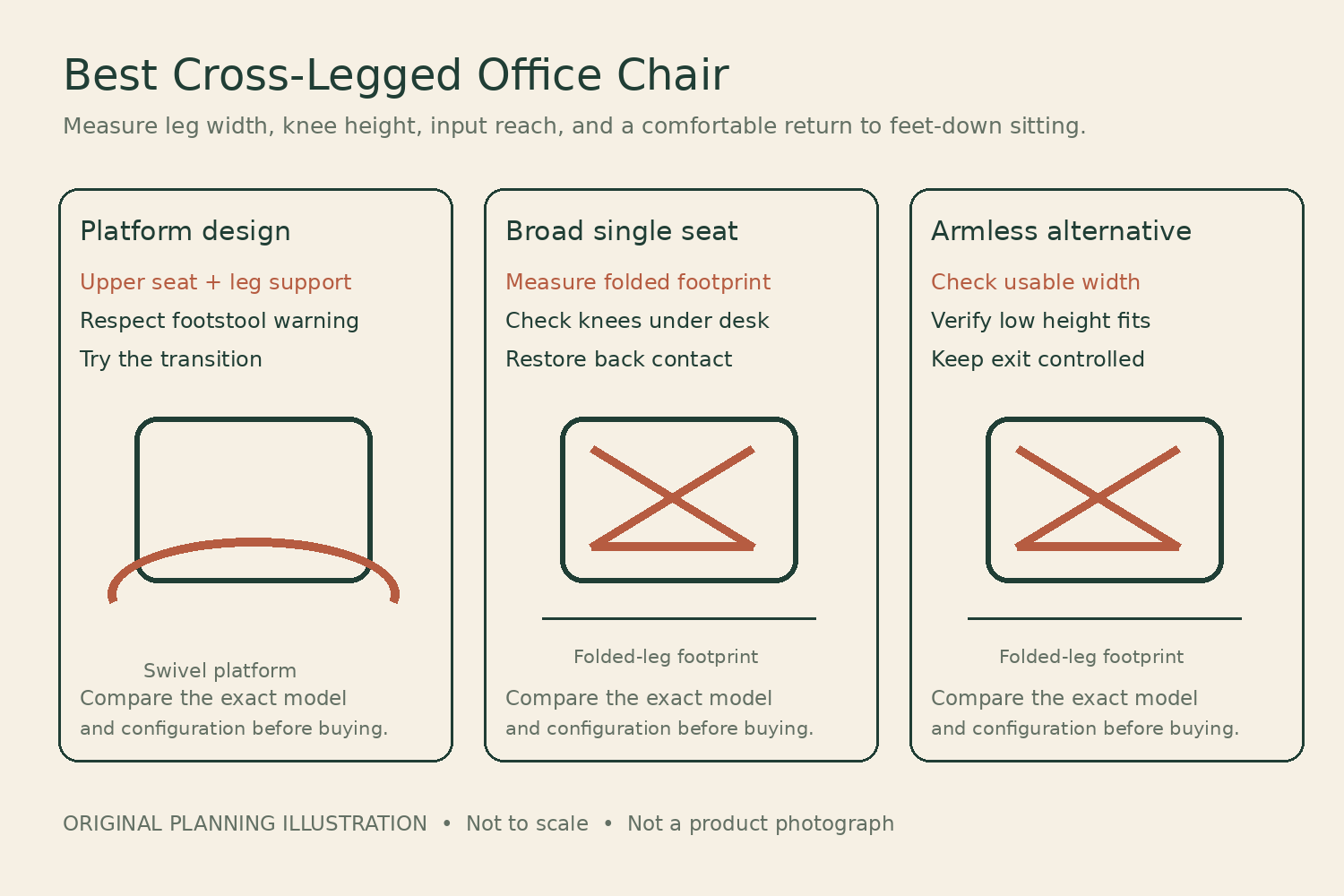
This is a research-based buying guide checked November 6, 2026. We have not sat in these chairs or measured joint loads, comfort, or concentration. A cross-legged chair is a furniture option, not a treatment for ADHD, anxiety, back pain, or another condition. Choose a posture that is comfortable for you and change it when needed; buying a specialty chair does not make one position appropriate for uninterrupted use.
Measure the shape your legs occupy
A chair’s width is only one dimension of cross-legged fit. Folded legs can occupy substantial depth, and your knees may extend beyond the cushion or strike the desk underside. The usable surface can also shrink around a back cushion, side bolster, or raised seam. A broad photographed seat may not support the particular arrangement you prefer.
Start with the comfortable position you already use on a suitable stable surface. Record its side-to-side footprint, its front-to-back footprint, and the height of the highest knee above the sitting surface. Do not force your knees into a smaller rectangle to justify a purchase. If the position is uncomfortable before a chair is involved, another seat width is not evidence that the position will become appropriate.
Compare the support construction
| Model | Leg support | Published contact dimension | Important tradeoff |
|---|---|---|---|
| Pipersong Pro | Separate swiveling lower platform | Upper seat 17.5 × 13.8 in | Transitions and platform loading |
| Pipersong Criss Cross | Single broad seat | Seat 27 × 22 in | Desk and back-contact clearance |
| Vari Criss Cross | Single armless seat | Seat 21 × 19 in | No arm support; smaller footprint |
Review the Pro design and its manufacturer model drawing, the broad-seat Pipersong specification, and Vari’s SKU-specific page. These are construction comparisons, not a ranking of experimentally measured comfort.

1. Pipersong Meditation Chair Pro
Best for: Best to investigate a separate swivel leg-support platform.
Pipersong Pro is the distinctive option when you want a small upper sitting cushion above a movable lower platform. It is not simply an extra-wide flat seat. The upper seat drawing gives 17.5 inches of width and 13.8 inches of depth, while the lower support swivels away for an ordinary seated position. That arrangement warrants a transition trial: the important question is how you move between positions without loading the lower platform improperly.
The Pro adds two inches of backrest adjustment compared with the fixed-back Plus. Its model-specific drawing lists a 19.3–23.2-inch seat height; the generic FAQ uses a different range, so obtain written confirmation if the minimum is critical. The same drawing recommends a three-by-three-foot space. The current US page showed both a sold-out label and an add-to-cart interface, leaving exact color availability unresolved until the variant is selected and confirmed.
Product Details
| Brand | Pipersong |
|---|---|
| Upper seat width/depth | 17.5 × 13.8 inches, drawing |
| Seat height | 19.3–23.2 inches, model drawing |
| Backrest adjustment | 2 inches |
| Warranty | 1-year limited manufacturing defects |
Pros
- Separate movable platform changes the leg-support arrangement
- Model-specific drawing gives useful contact dimensions
- Backrest height adjustment distinguishes Pro from Plus
Cons
- Upper seat is not an extra-wide cushion
- Platform warning and movement need careful attention
Investigate Pro only with a suitable trial and a confirmed orderable US variant. Pipersong gives a one-year limited warranty for manufacturing defects. Its FAQ explicitly warns never to sit or stand on the footstool alone, especially on one side. A 250-pound chair rating does not turn the lower platform into an independent stool, and this guide does not endorse the medical language in its marketing.
2. Pipersong Criss Cross Chair
Best for: Best broad-seat comparison when folding arms also matter.
The Pipersong Criss Cross takes the opposite route from Pro: one large 27-by-22-inch seat rather than an upper seat plus swiveling platform. The removable back cushion can flip backward to free more leg space. That makes it a candidate for someone who wants a broad sitting surface while retaining optional arm support during conventional desk work. Check the actual usable area with the cushion positioned as you intend to use it.
The manufacturer lists a 350-pound capacity and folding arms with fore-and-aft and lateral adjustment. Wheels and bell glides are both supplied, permitting an approved stationary configuration without improvising a base replacement. The current US page carried conflicting generic sold-out and purchase-interface labels, so check the selected color's checkout status rather than assuming immediate stock. Its nominally generous seat dimensions also require enough room beneath the desk for your knees in the folded position.
Product Details
| Brand | Pipersong |
|---|---|
| Seat dimensions | 27 × 22 inches, manufacturer |
| Backrest height | 19 inches, manufacturer |
| Arms | Foldable; 2.5-inch fore/aft and 30-degree lateral adjustment |
| Base options | Five wheels and five bell glides supplied |
| Warranty | 1-year limited manufacturing defects |
Pros
- Largest published single seat in this shortlist
- Folding arms preserve a conventional-work option
- Manufacturer supplies both rolling and stationary floor contacts
Cons
- Broad seat can make conventional back contact harder
- Variant inventory requires confirmation
Choose this construction only if ordinary sitting is also usable. Ask for the exact current seat-height drawing and trial it at your desk. The chair uses polyester upholstery, not leather. Its one-year defect warranty and thirty-day return policy have conditions, including packaging and condition requirements. A free-return label does not necessarily include a home pickup service or an unrestricted used-chair trial.
3. Vari Criss Cross Chair SKU403460
Best for: Best simpler armless comparison for a smaller folded-leg footprint.
Vari is the simpler armless alternative for someone who does not need a lower platform or folding arms. Its current dimension graphic gives a 21-inch-wide by nineteen-inch-deep seat and a 19–21-inch seat-height range. That is substantially narrower than Pipersong's broad-seat model, despite both being called Criss Cross. Measure your own folded-leg footprint instead of treating the shared name as a standard size.
The US page identified beige SKU403460 as in stock when checked and provided a purchase control. Its product comparison data lists 275-pound capacity, and the page describes five-year warranty coverage. There is no arm support to restore when you return to a conventional typing position. A clear desk layout and a comfortable return to feet-supported sitting therefore matter as much as the seat's open sides.
Product Details
| Brand | Vari |
|---|---|
| Seat dimensions | 21 inches wide × 19 inches deep, current dimension graphic |
| Seat height | 19–21 inches, current dimension graphic |
| Capacity | 275 lb, current page comparison data |
| Arms | Armless |
| Warranty | 5 years; terms apply |
Pros
- Straightforward armless construction
- Current US page identifies a specific in-stock SKU
- Manufacturer states a five-year warranty
Cons
- No arm pads for conventional work
- High minimum and narrower seat can exclude some users
Choose Vari only after confirming that the intended posture fits on its actual cushion and that the nineteen-inch minimum works for ordinary sitting. Its current direct page advertised thirty-day returns; obtain the exact conditions before assembly. Upholstery softness and the brand's comfort claims are not results of our testing. The simpler mechanism is useful only if it meets the positions you need.
The folded-leg and conventional-sit worksheet
Complete two rows for each candidate: one for your preferred folded-leg position and one for ordinary sitting with appropriate foot support. This avoids solving the unusual position while leaving the more familiar one unusable. Record the exact upholstery, cushion arrangement, and floor contacts because a glide configuration and a rolling configuration can behave differently during entry.
- Folded footprint: record width and depth of the comfortable position. Compare with usable cushion area, leaving space rather than balancing at its edge.
- Knee envelope: measure knee height above the loaded seat and the available vertical clearance below the desk. Include drawers, keyboard trays, and frame rails.
- Back contact: check whether your back can meet its intended support in both positions. A deep cushion may fit folded legs while leaving a gap during ordinary work.
- Input reach: try the keyboard and pointing device in each position. The desk should not become too distant because knees or chair arms prevent a close approach.
- Return and exit: put the feet down, move the platform if applicable, and stand following the instructions. Record any awkward movement or uncontrolled rolling.
For example, a person may measure a comfortable folded-leg footprint at 24 inches wide and twenty inches deep. Vari’s published 21-by-19-inch seat fails that initial rectangle test, while Pipersong’s 27-by-22-inch seat remains a fitting candidate. Pro cannot be screened using its upper cushion alone because the lower platform is part of its support arrangement. This example explains why one family label cannot substitute for a drawing; it does not establish that the larger chair will be comfortable.
Now suppose the same person needs a conventional loaded height below nineteen inches. Vari’s stated minimum and Pro’s model drawing both raise a second concern. Do not ignore that concern because the folded posture looks promising. Ask for a lower approved configuration, select another chair, or retain a separate suitable task seat.
The desk can be the limiting dimension
Check the underside of the desk before the chair arrives. A center drawer or low apron may hit a folded knee even when there is ample lateral room. Measure the actual opening at the place where you type. If you must push the chair away to avoid contact, recheck your reach to the keyboard rather than accepting the new distance automatically.
A laptop adds another constraint because its display and keyboard share one body. Evaluate the installed equipment rather than only placing a laptop in a staged photograph. If separate input devices or a display support are required for your chosen task arrangement, include them in the purchase plan. The chair cannot create missing knee space or independently move a laptop screen.
Movement requires an exit plan
Cross-legged entry often involves bringing the feet onto the seat after sitting. Reversing that movement should be easy when the phone rings or you need to leave quickly. Follow the model’s instructions and keep the area clear. Never climb onto a rolling chair to create the posture shown in a product photograph.
Pipersong’s current FAQ specifically warns against sitting or standing solely on its lower footstool. Treat that warning as part of Pro’s buying decision. A movable platform is not an independent stool, step, or extra guest seat. For the broad Criss Cross model, use the supplied glides only as instructed if you prefer a stationary setup; do not install improvised blocks or mixed floor contacts.
Comfort claims need restraint
Specialty-chair pages often describe stimulation, focus, posture correction, or relief from discomfort. We do not use those claims as evidence for these recommendations. There is no verified chair-specific medical outcome in this comparison. If a condition affects your hips, knees, balance, sensation, or ability to change position, obtain appropriate individual guidance before relying on an unfamiliar arrangement.
During a permitted trial, stop using a position that causes pain, numbness, or other symptoms rather than treating discomfort as a training requirement. A useful chair should make comfortable alternatives available. It should not pressure you to remain cross-legged to justify its name or cost. Keeping another suitable seat nearby can make the evaluation less consequential.
Resolve availability and return conditions before ordering
The Pipersong pages presented a generic sold-out label alongside purchase controls when checked, so this guide does not promise stock in any particular color. Confirm the exact US variant and dispatch date with the seller. Vari’s beige SKU was identified as in stock on its current page. Neither finding guarantees the status of the matching Amazon search results below.
Pipersong’s one-year defect warranty differs from Vari’s stated five-year coverage, and both differ from a fit return. Pipersong’s returns have original-packaging and condition requirements, with different shipping treatment depending on the order. Ask whether assembly and a practical sitting trial are allowed, retain the carton, and obtain the cost of sending the chair back. A specialty layout is a poor blind purchase if the return process makes a useful evaluation impossible.
Use Pro when the separate platform is the construction you want to try, the broad Pipersong when a measured single-seat footprint and folding arms are essential, or Vari when its smaller armless arrangement already fits. Decide from both worksheet rows. The winning chair must support the transition back to ordinary work as well as the posture that attracted you to it.
Something unclear or out of date? Send a correction with this article’s title and the detail to check.
Sources, research & corrections policy ↗